xpict
Molecule depiction for publication-quality SVG — one Rust paint core, with RDKit layout at each language edge (Python, JavaScript/WASM, native Rust).
Two first-class APIs share the same paint:
| API | Shape | Good for |
|---|---|---|
| Single molecule | mol → render → toSvg |
One structure, options, align_to |
| Declarative document | nested JSON (type: "mol" / group) |
Batches and a document model that is still expanding |
Single molecule
Build a mol, render with options, turn the scene into SVG.
import { xpict } from "@xenosite/xpict";

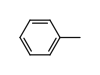
const benzene = xpict.mol("c1ccccc1");
const rendered = await xpict.render(benzene, {
  color: "#0b6e4f",
  atom_shade: [0, 0, 0.2, 0, 0, 0.9],
});
const svg = xpict.toSvg(rendered.scene);

// Align a second mol onto the first pose
const aligned = await xpict.render(xpict.mol("Cc1ccccc1"), {
  align_to: benzene, // or align_to: rendered
});

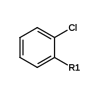
Star / Markush labels on this path use star_labels (chem markup OK) or a
CXSMILES trailer when star_labels is omitted:

Label markup · full option table in API overview.
Declarative document
Nested JSON — a strict subset of future PictSpec. Fields today are
structure, id, color, shade, and star_labels. Richer diagram nodes stay
under xpict.future until they graduate; every document must still validate as
future PictSpec.
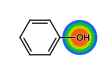
const [r] = await xpict.depict({
  type: "mol",
  smiles: "CCO",
  color: "#0b6e4f",
  shade: { atoms: [0.0, 0.2, 0.9], vmin: 0, vmax: 1 },
});
const svg = xpict.toSvg(r.scene);

const batch = await xpict.depict({
  type: "group",
  children: [
    { type: "mol", smiles: "*c1ccccc1Cl", star_labels: ["$R_1$"] },
    { type: "mol", smiles: "c1ccccc1O" },
  ],
});

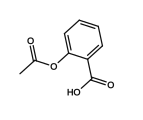
More depictions
Packages
| Language | Package | Docs |
|---|---|---|
| Python | xpict |
API |
| JavaScript | @xenosite/xpict |
API |
| Rust | xpict / xpict-core |
API |